
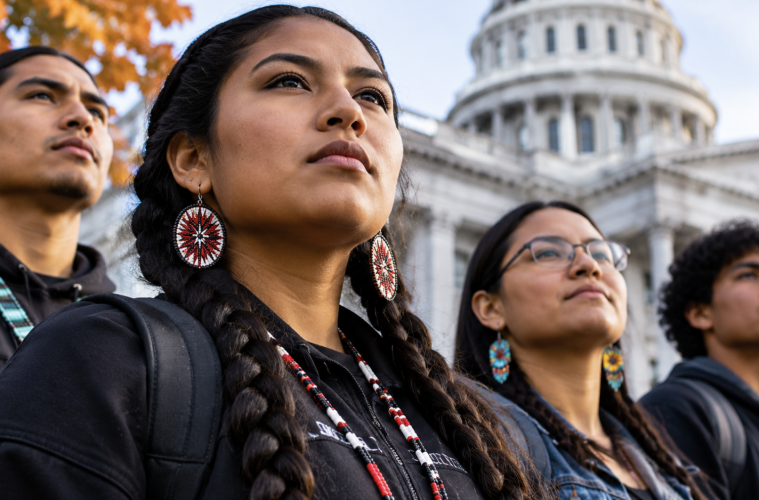
Some of the laws young Native Americans are fighting today were written before they were born.
Some of the political battles began generations before their parents were born.
And yet, as the nation prepares for the Nov. 3 midterm elections, young Indigenous advocates are stepping into state capitols, organizing their communities and demanding a voice in decisions that will shape their futures.
Their message is simple: They aren’t waiting for someone else to fix what previous generations couldn’t.
During an Oct. 9 briefing hosted by American Community Media, Native leaders and researchers described a political awakening among young Indigenous Americans, fueled by concerns over tribal sovereignty, cultural preservation, economic security and the future of their communities.
For Sage Phillips, co-coordinator of the Wabanaki Policy Youth Initiative in Maine, that awakening began with an intimidating trip to the state Capitol.
Phillips and a colleague traveled to Augusta to advocate for policies affecting Wabanaki communities. Entering a government building with a long and complicated history involving Indigenous peoples was not easy.
They were nervous. They questioned whether their voices would be welcomed.
But once inside, their perspective changed.
“Oh, we can do this. This is the people’s house,” Phillips recalled thinking.
That experience helped inspire the Wabanaki Policy Youth Initiative, a program designed to introduce young people to advocacy, government and public policy.
What began as an effort to help youth understand the legislative process has grown into something more ambitious.
Young organizers are now traveling throughout Maine, registering voters, speaking with candidates and educating their communities about decisions being made in the state Legislature.
And in an unexpected reversal of traditional roles, some are teaching their elders about the political issues affecting their tribal nations.
Fighting laws older than they are
One of the issues Phillips highlighted is the 1980 Maine Indian Land Claims Settlement Act, which has shaped the relationship between Maine’s federally recognized tribes and state and federal governments for more than four decades.
Wabanaki advocates have long raised concerns that the settlement framework limits their tribes’ ability to benefit from certain federal laws available to other federally recognized tribes.
Phillips said today’s young advocates are entering the same political spaces as their ancestors to address unresolved questions of tribal rights and sovereignty.
“We’re not asking for special treatment, we’re just asking for equality and fairness,” Phillips said.
The youth initiative has also focused on strengthening implementation of Maine’s Wabanaki studies requirement, originally enacted in 2001.
For these young organizers, the issues are not abstract political talking points. They involve their history, their identity and the rights their communities will carry into the future.
A new urgency among young Native voters
Judith LeBlanc, executive director of Native Organizers Alliance, said her organization’s work in communities across the country has revealed a growing sense of urgency among younger Native Americans.
LeBlanc, a citizen of the Caddo Tribe of Oklahoma, said young people are increasingly paying attention to political decisions and the consequences of government policies.
She suggested that social media may be contributing to that urgency by exposing younger generations to conflicts, injustice and suffering beyond their immediate communities.
But their involvement extends well beyond online conversations.
Native Organizers Alliance has supported community organizing efforts focused on voter engagement, local needs and political participation.
For LeBlanc, the growing involvement of young people represents an opportunity to build lasting political influence rather than simply increase turnout for a single election.
More than Democrats and Republicans
Michael Roberts, president and CEO of First Nations Development Institute, cautioned against viewing Native Americans as a single voting bloc.
Like other Americans, Native voters are concerned about jobs, housing, inflation and the cost of living.
But they also bring concerns that often receive less attention in mainstream political coverage: tribal sovereignty, treaty rights, Native languages, ancestral lands and cultural preservation.
Those issues matter whether Native people live on reservations, in rural communities or in major cities.
Roberts also questioned whether political campaigns are doing enough to engage Native voters, pointing to research conducted by his organization during the 2024 election cycle.
His broader message was that Native Americans should not be treated as an afterthought in discussions about the country’s political future.
The right to vote isn’t always easy to exercise
Even as young Indigenous organizers encourage political participation, significant barriers remain for some Native voters.
Melissa Rogers, a professor of politics and policy at Claremont Graduate University, described research documenting challenges involving distant polling locations, limited postal services and identification requirements.
Some residents of tribal lands lack conventional street addresses or must travel considerable distances to access election services.
Rogers said reducing those obstacles can increase participation and strengthen confidence in the electoral process.
The challenges underscore an uncomfortable reality: Encouraging people to vote means little if the process itself remains difficult to navigate.
They’re not waiting for tomorrow
For generations, Native American communities have fought to protect their lands, languages, treaty rights and political sovereignty.
Today’s young organizers have inherited those struggles, but they are also developing their own strategies.
They’re entering legislative chambers, questioning candidates, organizing neighbors and making sure younger children understand the issues they may one day confront.
And while elections provide an opportunity to influence government, their work doesn’t begin or end at the ballot box.
Phillips offered perhaps the clearest description of what this generation is demonstrating:
“We always like to say that our youth are our leaders of tomorrow, but they’re also doing a pretty good job in leadership and advocacy today.”
The next generation of Native American leaders isn’t waiting for permission to participate in democracy.
They’re already doing the work.
