
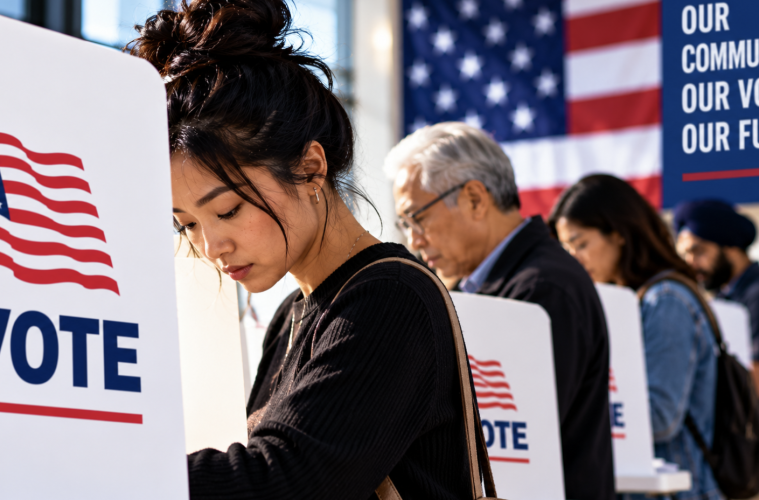
Asian American and Pacific Islander voters could play an important role in several closely contested races on Nov. 3, but new research suggests that many remain overlooked by political campaigns despite their growing electoral influence.
The United States has approximately 16 million eligible AAPI voters, including 1.6 million who have become eligible since the 2022 midterms, according to AAPI Data.
A national survey released in August found that 90% of registered AAPI voters plan to participate in this year’s elections, compared with 84% before the 2022 midterms. Seventy-one percent said they were absolutely certain they would vote.
Those findings were among the issues discussed during an Oct. 16 American Community Media news briefing examining the changing political priorities of Asian American and Pacific Islander communities.
Karthick Ramakrishnan, founder and director of AAPI Data, cautioned that enthusiasm alone does not guarantee turnout. Work schedules, voting restrictions and limited access to reliable election information can prevent otherwise motivated voters from casting ballots.
Economic Concerns Drive Voter Priorities
The 2026 AAPI Voter Survey, conducted with APIAVote, identified the cost of living and inflation as leading concerns.
Ninety percent of Asian American respondents and 89% of Pacific Islanders described those issues as very or extremely important in deciding how to vote.
Health care, employment, education and public safety also ranked prominently.
Although Democratic candidates hold an overall advantage among surveyed voters, the findings reveal differences across ethnic communities.
In Senate races, for example, 66% of Asian Indian respondents preferred Democratic candidates, compared with 22% who favored Republicans. Among Filipino respondents, 49% preferred Republicans and 42% favored Democrats.
The figures illustrate why researchers caution against viewing the AAPI electorate as a single political bloc.
Shekar Narasimhan, chairman of the AAPI Victory Fund, told reporters that political campaigns must recognize those differences rather than assume support from any community.
Many Voters Remain Unreached
Despite growing political attention, the survey found that 42% of registered AAPI voters had not been contacted by Democrats, while 58% reported no contact from Republicans.
Community organizations are helping fill that gap, often through conversations conducted in voters’ preferred languages.
Mary Lou Akai-Ferguson, executive director of the Asian American Power Network, said affiliated organizations had knocked on 450,000 doors and completed more than 85,000 telephone conversations nationwide as of Oct. 15.
But she warned that reduced funding has forced organizations to eliminate or scale back programs designed to reach younger voters and people who do not participate consistently in elections.
In Georgia, she described community gatherings called Chai and Chat, where residents could ask questions about government and elections in an informal setting. Similar outreach efforts, she said, require resources months before Election Day.
In Nevada, funding shortages prevented organizers from hiring two staff members who would have focused on Korean American and Chinese American communities.
The cuts could limit opportunities to address voters’ concerns before they reach the ballot box, she said.
Language and Voting Access Matter
Christine Chen, executive director of APIAVote, emphasized that voter education must reflect the different languages, immigration experiences and political backgrounds within AAPI communities.
She also raised concerns about changes to voting procedures, including identification requirements, mail voting rules and polling locations.
Such changes can create confusion for first-time voters and longtime voters alike, particularly when information is not readily available in their preferred language.
The survey found that family and friends were among the most trusted sources of information for AAPI voters, followed by academic experts, community journalists and local organizations.
A Growing Voice in Close Elections
AAPI voters represent meaningful shares of the eligible electorate in several competitive states, including Nevada, Arizona, Georgia, Pennsylvania and Michigan.
Their influence will depend not only on population growth but also on turnout, access to voting and whether campaigns engage voters on the issues that matter to them.
As the midterms approach, the research offers a reminder that Asian American and Pacific Islander voters are neither politically uniform nor guaranteed to participate.
Their growing numbers create electoral potential. Whether that potential translates into votes remains an open question.
