
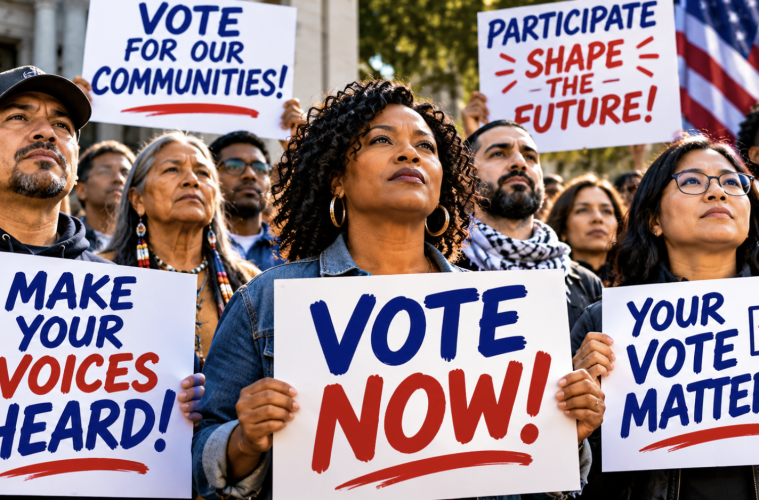
Community journalists describe how immigration concerns, discrimination and questions about political representation are influencing conversations ahead of Nov. 3.
Fear can silence people. It can also motivate them to speak out.
With the Nov. 3 midterm elections approaching, journalists covering some of America’s most diverse communities say residents are wrestling with both reactions as they consider the country’s political direction.
During an Oct. 30 national roundtable hosted by American Community Media, six journalists discussed the concerns they are hearing from the communities they cover.
The conversation revealed a complicated picture. Some residents are increasingly interested in political participation, while others are hesitant, frustrated or uncertain about whether their voices will make a difference.
And sometimes, those competing emotions exist within the same community.
Fear and determination in Latino communities
In Los Angeles, Néstor Fantini, co-editor of Hispanic LA, said immigration enforcement and the cost of living are among the issues weighing heavily on Latino residents.
Fantini described conversations with residents and community leaders who expressed concern about immigration enforcement and its potential effects on families.
But he also reported determination among people who do not want those concerns to discourage political participation.
“There is fear. There’s no doubt that there’s fear,” Fantini said.
He later described a contrasting sentiment: “Determination not to be intimidated.”
Fantini said community organizations were working to encourage participation and address voters’ concerns.
His observations illustrated a central question facing the election: Whether anxiety about government policies will discourage some eligible voters or strengthen their resolve to participate.
When belonging feels uncertain
In Silicon Valley, Vandana Kumar, publisher and CEO of India Currents, described how immigration uncertainty is influencing civic engagement among some Indian Americans.
Kumar said concerns about employment, immigration status and acceptance in American society can make people reluctant to speak publicly.
“We all know that fear can silence people,” she said.
Kumar explained that immigrants holding temporary visas or awaiting permanent residency may hesitate to draw attention to themselves because of concerns about their immigration status.
But she also emphasized that political concern does not produce the same response in everyone.
“For some, uncertainty about belonging makes political involvement more urgent,” Kumar said. “For others, it creates hesitation.”
She noted that some immigrants are engaged in political discussions but are not eligible to vote, while some eligible voters question whether their participation matters.
Her comments underscored the difference between caring about political issues and participating in an election.
Mississippi’s struggle for political representation
In Mississippi, Edelia Carthan, a contributing writer for The Mississippi Link, connected current political concerns to the state’s history of racial discrimination and struggles over Black political representation.
Carthan discussed rising living expenses, health care access, diversity, equity and inclusion policies, and disputes over redistricting.
She said those issues are drawing attention to the state’s U.S. Senate election.
Carthan also described enthusiasm among some residents about the possibility of changing the state’s political representation.
But she acknowledged that excitement surrounding a campaign does not necessarily guarantee voter participation.
Her observations reflected the importance of history and representation in shaping how some Black voters approach elections.
Arab American concerns about discrimination
In Dearborn, Michigan, Osama Siblani, publisher of The Arab American News, expressed concern about hostility and discrimination affecting Arab and Muslim Americans.
Siblani spoke passionately about the political climate and described his personal concerns about rhetoric directed at his community.
He also emphasized that Arab American families face economic challenges familiar to many Americans, including the cost of food, gasoline and health care.
For Siblani, those concerns are connected to broader questions about civil rights and political participation.
“We need to protect our democracy. We need to protect our freedom in this country,” he said.
His remarks reflected his belief that voting is an important response to the concerns he described.
Different communities, different motivations
Other journalists participating in the discussion described additional factors shaping political interest.
In New York, Rong Xiaoqing, a reporter for Sing Tao Daily, said she was observing strong interest in early voting in the Chinese American neighborhoods she covers.
She also noted differences of opinion within the community, including contrasting views on immigration enforcement.
In southeastern Idaho, Lori Ann Edmo, editor of Sho-Ban News, discussed how federal funding decisions, tribal sovereignty and treaty rights are affecting political conversations among Native Americans in the communities she covers.
Edmo said those concerns, along with rising living costs, were encouraging efforts to increase voter participation.
The perspectives reinforced an important distinction: Communities may share economic frustrations without sharing the same political priorities or views about government policies.
Will concern become participation?
Throughout the briefing, the journalists repeatedly returned to the difference between political concern and electoral participation.
Residents may follow political developments closely without voting. Others may feel personally affected by government policies but lack voting eligibility.
Some may hesitate to participate because of uncertainty or fear. Others may view the same concerns as reasons to become more politically involved.
The journalists’ accounts reflected their reporting experiences and community conversations. They were not presented as nationally representative surveys or predictions of election results.
Still, the discussion raised a question that will remain unanswered until voters cast their ballots Nov. 3:
When people feel that their futures are uncertain, will they withdraw from the political process — or become more determined to make their voices heard?
