
HOUSTON — Sometimes the answers to the future are hiding in lessons people have carried for generations.
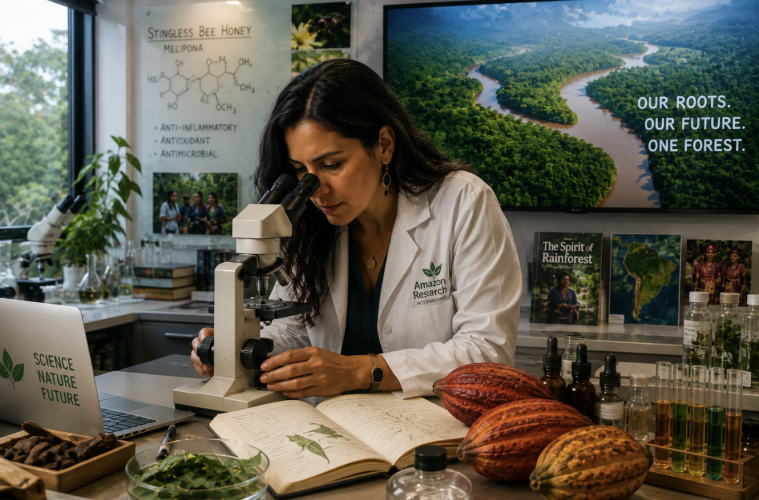
That was one of the most compelling ideas to emerge from an American Community Media briefing featuring Dr. Rosa Vásquez Espinoza, a Peruvian chemical biologist, National Geographic Explorer, author and founder of Amazon Research Internacional. Her work brings modern scientific research together with ancestral Amazonian knowledge to better understand biodiversity, medicine, conservation and the relationship between people and the natural world.
Raised between the Peruvian Andes and rainforest, Vásquez Espinoza said Indigenous communities have long understood something modern society often forgets: people and nature are deeply connected.
“If I as a human being have the rights to have access to a healthy forest and healthy waters, the animals around me and the plants around me do too,” she said. “Because if they are not healthy, me as a human being, I am not healthy.”
That philosophy is not simply spiritual. Vásquez Espinoza said generations of observation and experimentation have created bodies of Indigenous knowledge that increasingly intersect with findings from modern science.
“I feel like in a way modern science is catching up with ancestral knowledge,” she said.
She explained that traditional knowledge often follows a process remarkably similar to the scientific method: observing nature closely, asking questions, testing what works and passing those conclusions from one generation to the next. That is how communities learned which plants could serve as medicine, which could be dangerous and how foods could be prepared safely.
One example is the stingless bee, an ancient pollinator found throughout tropical regions. Vásquez Espinoza initially began studying the bee’s medicinal honey after Indigenous communities told her they were using it during the COVID-19 pandemic. Her research eventually revealed a much larger story—one involving ecology, food, medicine, culture, livelihoods and opportunities for women and young people.
That connection between traditional knowledge and modern challenges also extends to food.
Vásquez Espinoza pointed to emerging archaeological research showing that communities in the Amazon were cultivating cacao and developing sophisticated agricultural and water-management practices thousands of years ago. She said that history matters today as the world searches for better ways to feed growing populations amid increasing pressure on food systems.
“What could we learn from that existing knowledge that exists right now through the living elders?” she asked.
For people living nowhere near the Amazon, those lessons can still feel remarkably personal.
During the briefing, Vásquez Espinoza spoke about the way knowledge moves through families—from grandparents to children and grandchildren, sometimes through ordinary moments at home. In discussing similarities she has seen across Indigenous and traditional cultures, she described elders sharing lessons while caring for hair, preparing remedies or telling stories to younger generations.
That idea—wisdom passed quietly from one generation to another—became one of the strongest themes of the conversation.
Asked what message from her book, The Spirit of the Rainforest, she hopes people remember, Vásquez Espinoza offered a simple answer.
“The future is ancestral, too,” she said. “There is so much that we can learn from our roots.”
And those roots, she added, don’t necessarily mean a particular family or place.
“I think roots also means nature,” she said. “We don’t need to go to the depths of the earth to feel reconnected. We can also remember to step outside and look at the sky or focus on the one tree we have near us.”
Her message also carried a practical challenge.
Environmental problems can seem so enormous that people begin to believe their own actions won’t matter. Vásquez Espinoza argued the opposite.
“I am a big proponent to say to change the world we need to first just focus on what’s around us and what can we change,” she said. “Even though it may feel minuscule and we’re not doing enough, if we all focus on that we would achieve change much faster than anything we’ve ever seen before.”
For Vásquez Espinoza, resilience itself may be another lesson the Amazon has to offer.
She described communities that have endured displacement, exploitation and broken trust, yet continue working together with an eye toward generations they may never meet.
“They’re worried about the generation of their great-grandkids, even though they’re not born today,” she said. She described that willingness to rebuild and work collectively as “such a spirit of kindness and resilience.”
Perhaps that is what makes the Amazon’s ancient wisdom feel surprisingly modern.
The lesson isn’t that everyone needs to become a scientist or conservationist. It is that progress does not always mean abandoning what came before. Sometimes moving forward means listening again—to our elders, to our communities, to nature and to knowledge that has been quietly waiting for us to recognize its value.
And maybe, as Vásquez Espinoza suggests, the future isn’t entirely ahead of us.
Maybe part of it has been with us all along.
