
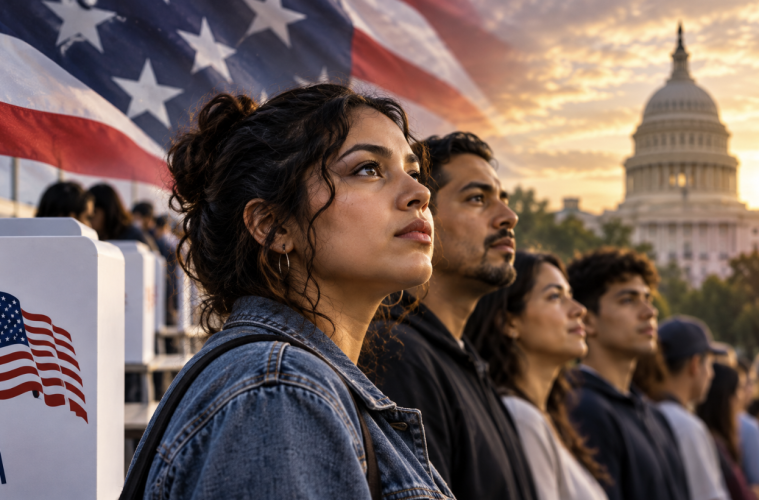
Latino voters made significant moves toward Donald Trump in 2024. Less than two years later, political researchers say the more lasting story may not be a Republican realignment at all.
Instead, Latino voters are showing signs of weaker attachment to both major parties, growing identification as independents and a willingness to move between candidates based largely on economic conditions and whether voters believe leaders are delivering results.
That was the central theme of an American Community Media national briefing held on Aug. 28, examining the Latino electorate ahead of the 2026 midterm elections.
María Isabel Di Franco Quiñonez, senior research director at Equis Research, said recent polling and election results point toward a more politically fluid electorate.
“What we had actually started to see was a dealignment — less Latino voters identifying with the Democratic Party and more identifying as independents,” she said.
Equis’ latest polling found about 14% of Latino voters who supported Trump in 2024 now say they would support a Democrat in November, while another 10% remain undecided, according to Di Franco Quiñonez.
That does not mean those voters have embraced the Democratic Party.
“We’ve seen great levels of skepticism and frustration with both parties,” she said.
Economics over ideology
The panelists repeatedly returned to one factor driving that fluidity: the economy.
Clarissa Martínez De Castro, vice president of the Latino Vote Initiative at UnidosUS, said four of the five leading issues among Hispanic voters in the organization’s polling are pocketbook concerns — cost of living, wages and jobs, housing and health care — followed by immigration.
A national UnidosUS survey of 3,000 registered Latino voters also found 19% undecided in their congressional preference, while 76% said they were certain or almost certain to vote in the midterms.
Eli Valentin, assistant dean at Virginia Union University and author of Politicking in the Barrio, cautioned against interpreting recent support for candidates on different ends of the political spectrum as evidence of a broad ideological shift.
“I think that this is a material movement before it is an ideological movement,” Valentin said.
He described economic conditions and anti-establishment sentiment as important factors behind some of the seemingly contradictory voting patterns appearing around the country.
Immigration is more complicated, too
The panel also challenged another common assumption: that Latino voters can be understood primarily through immigration.
Martínez De Castro said economic issues remain dominant, but that doesn’t mean immigration is unimportant.
She said polling shows distinctions between support for an orderly immigration system and concerns about immigration enforcement inside U.S. communities. She also said legalization for long-term undocumented residents remains a priority among many Hispanic voters.
Mike Madrid, Republican political strategist and author of The Latino Century, similarly argued that movement away from Republicans should not automatically be interpreted as renewed loyalty to Democrats.
“Notice, I’m not saying to Democrats. I’m being very deliberate in my word choice,” Madrid said. “They’re moving away from Republicans.”
That distinction could be one of the most important to watch as November approaches.
The Latino electorate may not be undergoing the “historic realignment” once predicted. Instead, the data and analysis presented during the briefing point toward something less predictable: millions of voters whose support cannot simply be assumed by either major party.
