
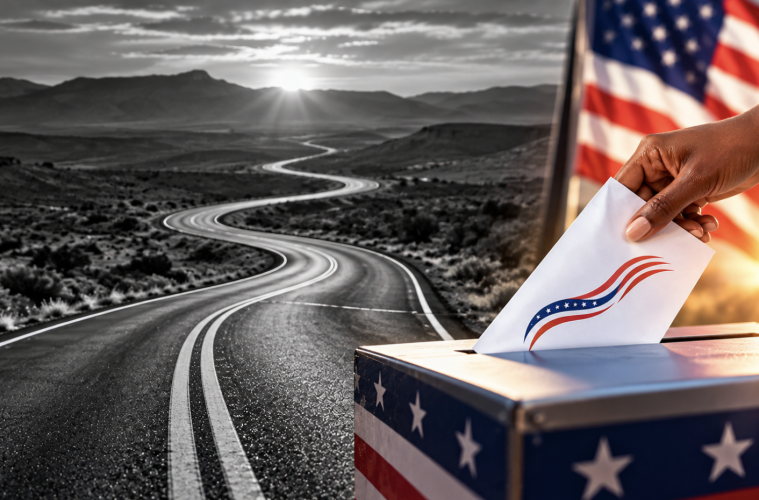
For some Americans, voting requires more than registering and showing up on Election Day.
It can mean traveling dozens of miles to a polling place. Finding transportation to obtain an acceptable ID. Navigating changing election rules. Overcoming language barriers. Or determining whether a ballot can be cast by mail.
Those challenges are not uniform across the country, but voting-rights advocates say they can disproportionately affect communities that have historically faced difficulty accessing the ballot.
During a recent American Community Media briefing on barriers facing ethnic voters in the 2026 midterms, Jacqueline De León, senior attorney with the Native American Rights Fund, described some of the most striking geographic obstacles.
Native voters in some communities must travel 20, 30, 40, 50 and sometimes as far as 100 miles to access a ballot box or voter-registration opportunity, she said. Some reservation residents also lack conventional street addresses or residential mail delivery, creating additional complications for registration and voting by mail.
“We can have really a compounding storm of factors that make it very difficult for Native voters to vote,” De León said.
Her organization plans to deploy roughly 300 poll watchers across Indian Country for the November election to document problems and report them to attorneys who can respond when necessary.
When identification becomes the barrier
In Georgia, Monica Spencer of VoteRiders said obtaining the identification needed to vote can create a different set of challenges.
Her organization assists eligible voters with obtaining IDs and underlying documents such as birth and marriage certificates and provides transportation when necessary.
The burden can be particularly difficult in rural communities, Spencer said, where public transportation, taxis and rideshare services may be unavailable.
She said her organization also encounters elderly voters struggling to renew identification, people who have lost documents and voters who were born at home and may not have traditional birth certificates.
Different state, different obstacle
In Texas, Mi Familia Vota field director Jesus Zamora described a system in which voter-registration applications generally still must be submitted physically rather than completed entirely online.
Transportation can present another obstacle. Zamora said canvassers have encountered voters who report being a 30- to 40-minute walk from their nearest polling location without access to a car or other transportation.
John C. Yang, president and executive director of Asian Americans Advancing Justice | AAJC, pointed to another challenge: fear and misinformation.
Yang told reporters that concerns about immigration enforcement at polling locations were, at the time of the briefing, rumors rather than confirmed reports. He urged voters to learn the rules in their jurisdictions and not allow misinformation to discourage them from participating.
“Don’t let the misinformation dissuade you from voting,” Yang said.
The differences among the communities illustrate why there is no single story about voting access in America.
For one voter, the obstacle may be identification. For another, it may be language, transportation, distance or uncertainty about changing election procedures.
And for someone living dozens of miles from the nearest place to register or vote, access to the ballot can begin with something much more basic: finding a way to get there.
