
By: Natalie Greene
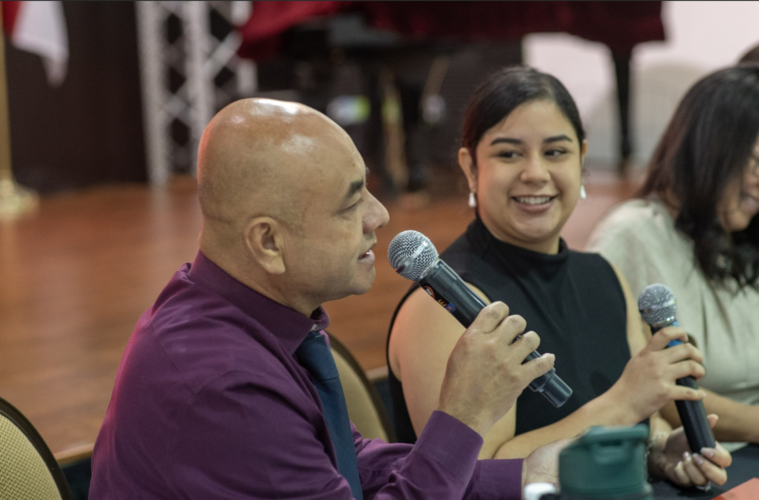
In the end, it was a daughter who would not let go and it paid off. Daniela has spent years routing strangers to help on an immigrant hotline. On Citizenship Day in Houston – Sept. 17 – she stood beside her parents and told a room full of advocates what it took at home.
“It’s taken my parents about 25 years to get to where they are today,” she said. “The urgency was the elections,” she added, “but also… I just want you to be safe.” Translating for her mother, she offered the line that doubles as a civic nudge: “They can do it now… and then we can vote.”
That family scene is the unofficial banner for Houston’s naturalization sprint—a coalition effort moving residents from green cards to the oath while the rules tighten in mid-October.

The campaign—Naturalize Now, Houston—is coordinated by the National Partnership for New Americans (NPNA) with Harris County, the City of Houston, and a web of community partners. Since last fall, said NPNA’s Angie Dupree, the Citizenship Community Navigators have “been outreaching to about 118,000” people, and “about… 10,000 applications” went to USCIS in the second quarter. Houston’s field office has ranked first or second in “five of the past six” quarters.
Hesitation doesn’t always trace to grammar. “We’re building confidence, self-esteem… and digital literacy,” said Ashley Borjon of the Literacy Council of Fort Bend County. Her students—often women who have lived here for decades—pose the same anxious test: “Can I even accomplish this at this point in my life? I’m 64, I’m retired… Can I communicate it in confidence in English?” The result, she said: “They did not anticipate that they would be built up in ways they didn’t imagine.”
Sometimes the bridge is simply a person who knows the process. “We had circles where people wanted to apply but were hesitant,” said Janette Diep of Boat People SOS. One participant “just wanted to have someone to confirm that she was OK to apply… I think it only took her like a month… she was naturalized really fast.”
The most pointed moment came when Zenobia Lai of the Houston Immigration Legal Services Collaborative (HILSC) broke a common misconception, explaining there “is no line” from Temporary Protected Status (TPS) or DACA to citizenship.
Those programs are shields, not ladders; they provide temporary protection and work authorization but do not create eligibility for a green card and do not put someone “in line” for naturalization. To become a citizen, a person must first become a lawful permanent resident through a separate pathway. For those who do have that doorway right now, her advice was blunt: “Being an American citizen is the ultimate protection against deportation… Now is the time.”
The timeline gives that counsel teeth. For N-400 applications filed on or after Oct. 18, officers will ask 20 civics questions from a 128-question bank; 12 correct answers are required to pass. USCIS has also broadened how officers assess “good moral character,” with fresh emphasis on unlawful voting and false-claim issues, and field investigations under INA §335 may include interviews with neighbors or employers.
Money remains a drag. “The filing fee just keeps going up… with the current $760… there are not that many families who can afford that,” said AJ Durrani of Emgage.
Fee help exists. The N-400 is $760 online, with a $380 reduced-fee option for eligible low- to moderate-income applicants and full waivers for those who qualify. Local partners can help cover what’s left. Workshops and navigator referrals are listed at NaturalizeNow.org. HILSC’s Immigrant Resource Hotline is 1-833-HOU-IMMI (1-833-468-4664), and a local guide is posted at BecomeACitizenToday.com.
