
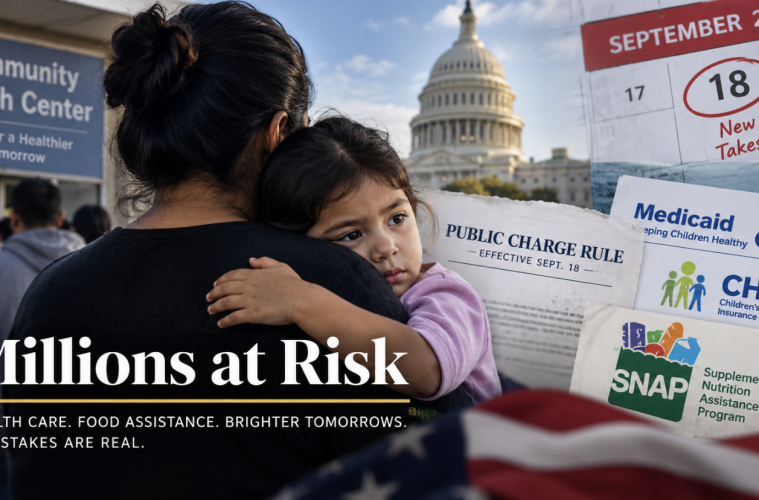
Millions of people, including children, have dropped from federal health and food assistance programs as immigrant families brace for a broader public charge policy scheduled to take effect Sept. 18.
During an American Community Media national news briefing on Aug. 7, immigration and public health experts warned that uncertainty surrounding immigration policy is already discouraging some families from accessing benefits, including assistance for U.S.-citizen children.
The Trump administration’s expanded public charge standard will give immigration officials broader discretion when determining whether certain green-card applicants are likely to become dependent on public assistance.
But experts said the impact could reach far beyond the immigrants directly subject to the rule.
“The fear is bigger than the rule,” said Xiao Wang, CEO and co-founder of Boundless Immigration.
Wang cited previous research showing that during an earlier expansion of public charge, one in five adults in immigrant families reported avoiding public benefits because of immigration-related fears. Among low-income immigrant families, that figure rose to three in 10.
That chilling effect can spread throughout a household. Benefits received by family members, including Medicaid or food assistance for U.S.-citizen children, generally are not considered benefits received by the person applying for a green card, Wang explained. Yet families may still withdraw eligible children from programs out of concern that participation could affect a parent’s immigration status.
2.3 million fewer children enrolled in Medicaid and CHIP
Joan Alker, executive director of Georgetown University’s Center for Children and Families, said Medicaid and the Children’s Health Insurance Program, or CHIP, provide coverage to a significant share of the nation’s children.
As of June 2026, Alker said 2.3 million fewer children were enrolled in Medicaid and CHIP than in January 2025.
She called it “a devastating number.”
Researchers do not yet know how many of those children have become uninsured or precisely what has driven the entire decline. Alker said, however, that fear among mixed-status families is believed to be one contributing factor, along with broader concerns surrounding immigration enforcement and the sharing of Medicaid and CHIP information with immigration authorities.
The potential reach is significant. Alker said about one in four U.S. children lives in a mixed-status family, which she described as a household with a U.S.-citizen child and an immigrant or naturalized parent.
Loss of coverage can have lasting consequences. Historically, Alker said, declines in children’s Medicaid enrollment have been accompanied by increases in the uninsured rate, making it harder for families to access primary and preventive care.
SNAP enrollment drops by 4.5 million
Similar declines are occurring in the Supplemental Nutrition Assistance Program, or SNAP.
Dr. Giridhar Mallya, a public health physician and senior policy officer at the Robert Wood Johnson Foundation, said SNAP participation fell by 4.5 million people over nine months, including nearly 1.5 million children.
“These are declines, enormous declines that we haven’t seen since the 1990s,” Mallya said.
Mallya said the decline cannot simply be attributed to an improving economy. He pointed instead to policy changes and burdensome paperwork requirements as factors pushing people from the program.
He also warned of additional changes ahead. According to Mallya, recently enacted provisions are expected to cut nearly $200 billion from SNAP over the next decade, shift some program costs from the federal government to states and restrict eligibility for some lawfully present immigrants, including refugees, asylees and trafficking survivors.
The effects can follow children into the classroom. SNAP participation can automatically qualify children for free or reduced-price school meals. Losing SNAP can mean losing that automatic qualification, requiring families to complete a separate eligibility process for school meal assistance.
Sept. 18 becomes a critical date
For immigrants currently preparing green-card applications, timing matters.
Wang said applications filed before Sept. 18 will remain subject to the narrower public charge standard currently in place, even if the cases are adjudicated after the new policy takes effect. The new standard will apply to applications filed beginning Sept. 18.
He encouraged eligible applicants who are ready to file to do so before the deadline and urged families to seek assistance from qualified immigration attorneys or authorized nonprofit immigration service providers rather than relying on rumors or generalized information.
The public charge standard does not apply to every immigrant, and receiving public assistance does not automatically jeopardize a person’s immigration status.
Yet experts warned that complicated rules, changing eligibility requirements and heightened immigration concerns can make those distinctions difficult for families to navigate.
“Part of the motivation behind all these policies is to create confusion and fear,” Mallya said, adding that immigrant communities, communities of color and other underserved populations are likely to bear some of the greatest impact.
With millions already leaving Medicaid, CHIP and SNAP, experts say understanding exactly who is affected by the Sept. 18 public charge expansion — and who is not — will be increasingly important for families weighing immigration concerns against basic needs such as health care and food.
