
For years, climate change has often been explained through scientific measurements, rising global temperatures and long-term projections. But speakers during an American Community Media national briefing said those conversations are becoming more meaningful when they connect with something people already understand—their everyday lives.
During the briefing, “Climate Change: The Issue That Dropped Off the Political Radar,” climate scientists and community leaders discussed why many people are connecting with climate change through personal experiences rather than technical terminology. They said that shift is helping reshape how families understand the issue.
Karen McKinnon, a professor of statistics and the environment at UCLA, said advances in climate science have made it easier than ever to understand how climate change influences many extreme weather events. She said the next challenge is helping people understand what those changes mean in their own lives.
“I don’t think that the average person, if you say the world is going to warm by two degrees Celsius… what does that mean? That doesn’t resonate with people,” McKinnon said. “But as we all unfortunately experience these impacts and can also talk about how these impacts are linked to climate change, I think that has the potential to change the narrative.”
For McKinnon, that conversation became personal during a recent visit with family in Colorado.
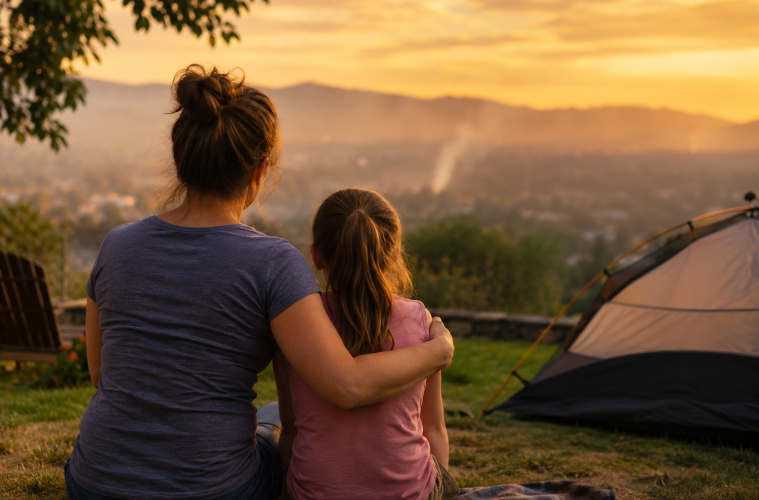
Her daughter wanted to camp outside in her grandparents’ backyard, but wildfire smoke blowing in from Colorado and Utah changed those plans.
“No, it’s not safe. You can’t camp out in the backyard,” McKinnon said. “When it gets to extreme heat, you have to say, ‘No, it’s not safe. You can’t actually be outside in these conditions.'”
McKinnon said those kinds of everyday experiences often resonate more deeply than scientific terminology alone because they help people connect climate science to situations they already recognize in their own lives.
“What we want back is a case where we’re not having smoke ruining our summers,” she said. “We’re not having the extreme heat ruining our summers. We’re really able to get back to a somewhat cooler and more stable climate state than we are right now.”
McKinnon also encouraged people to recognize that many of today’s weather extremes are unlike what previous generations routinely experienced.
“A lot of the things we’re seeing right now are unusual. They did not happen in the past,” she said. “In terms of the extreme heat and in terms of the wildfires, this is not normal in terms of what we would have seen 10, 20 or 30 years ago.”
While McKinnon focused on helping people relate to the science, Shina Robinson, resilience projects director for the Asian Pacific Environmental Network, said the language used to discuss climate also matters.
She said her organization has found that conversations become more productive when they begin with the values people already share rather than technical policy terms.
Using California’s Equitable Decarbonization Program as an example, Robinson said phrases such as “healthy and habitable homes” help families better understand what climate-related policies are intended to achieve.
“We’re talking about health. We’re talking about cleaner air in homes. We’re talking about lower asthma rates. We’re talking about safety for people’s kids,” Robinson said.
Mark Valentine, founder of ReFrame It Consulting and senior advisor to the Omega Resilience Awards, said helping people connect those everyday experiences to the broader climate conversation remains an important part of public communication.
“There’s certainly a disappearing coverage of the phenomenon of climate change, but there’s an abundance of coverage about wildfire and heat and drought,” Valentine said. “I think what’s missing is connecting those dots together for people.”
Throughout the briefing, the speakers returned to a common message: families often understand climate change not through abstract scientific concepts, but through experiences they can see, feel and discuss together. Whether it’s changing summer routines, concerns about children’s health or conversations around the dinner table, they said those lived experiences are helping reshape how people understand climate change.
