
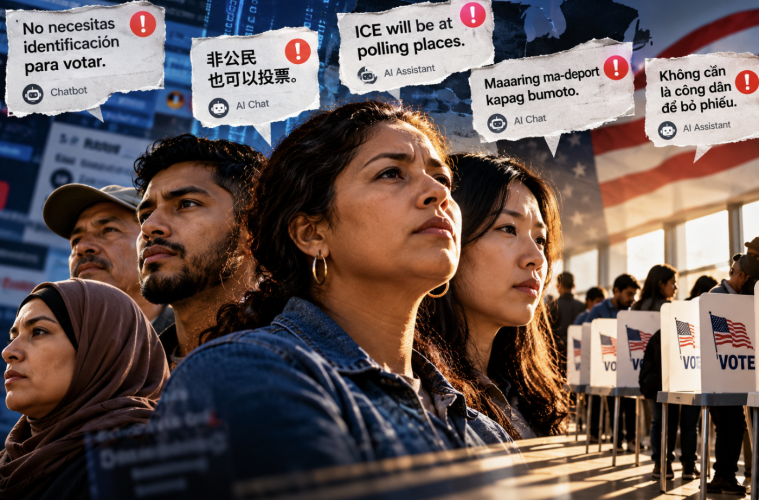
With the November 3 midterm elections approaching, misinformation about voting rights, election procedures and immigration enforcement is spreading through social media networks and artificial intelligence platforms, raising concerns about its impact on eligible voters across the country.
Experts participating in an October 23 national news briefing hosted by American Community Media warned that false information is increasingly reaching immigrant communities through trusted social networks, messaging applications and AI chatbots. Language barriers and limited access to reliable information can make misleading claims especially difficult to challenge.
The briefing, Who Gets the Last Word? Election Disinformation in Immigrant Communities, examined how misleading narratives travel across languages and platforms, often exploiting fears about immigration status and government enforcement.
When AI Gets Election Information Wrong
Laura Zommer, co-founder and CEO of Factchequeado, highlighted research by the Institute for Strategic Dialogue that found significant differences in the accuracy of AI-generated election information in English and Spanish.
According to the findings she presented, approximately 30% of English-language chatbot responses were incorrect, incomplete or outdated. In Spanish, that figure rose to 45%.
In one example, Zommer said Meta’s chatbot twice incorrectly identified November 4 as the date of the 2026 midterm elections when questioned in Spanish. Election Day is November 3.
The research also found that AI chatbots cited fewer sources when responding in Spanish, raising concerns about the reliability of information available to voters who rely on languages other than English.
Zommer said Factchequeado is conducting additional research in Texas to examine whether AI responses change based on the language and political framing of election-related questions.
Preliminary findings suggest chatbots may sometimes produce responses that reinforce users’ existing views rather than challenge inaccurate assumptions.
Fear as a Political Weapon
Cameron Hickey, CEO of the National Conference on Citizenship, said misinformation can have consequences beyond confusing voters about election procedures.
He described AI-generated images portraying immigration enforcement agents intimidating voters at polling locations. Although the images were fabricated, Hickey warned that they could intensify existing fears among immigrant communities.
He also raised concerns about reports of immigration enforcement activity near polling places and the potential chilling effect on naturalized citizens who are legally entitled to vote.
False claims about widespread noncitizen voting present another challenge, Hickey said, particularly when they are amplified by influential public figures or presented without context.
Jinxia Niu, who leads the Chinese Digital Engagement Project at Chinese for Affirmative Action, described how those narratives affect Asian immigrant communities.
“It really turns this disinformation into immigration fear,” Niu said, explaining that concerns about enforcement and citizenship verification can discourage some eligible voters from participating.
Her organization’s research has examined how anti-immigrant narratives affect Chinese, Indian, Filipino and Vietnamese communities, sometimes creating divisions within the communities themselves.
A Misinformation Network That Crosses Borders
Niu said Chinese-language election misinformation has increasingly shifted from WeChat toward X, formerly Twitter, before being redistributed through other platforms and private messaging networks.
According to Niu, Chinese for Affirmative Action has identified more than 150 social media accounts associated with disinformation in the Chinese-language information environment.
She also described how recurring political narratives are repackaged for new election cycles, sometimes using AI-generated imagery to make familiar claims appear new or more convincing.
The organization’s report, Divided by Design, examines how fear-based narratives and limited access to trusted information contribute to misinformation within several Asian American communities.
For many immigrant voters, Niu explained, differences between voting systems in the United States and their countries of origin can create additional confusion. Claims about voter identification requirements, citizenship verification and election fraud can exploit those differences.
The Challenge of Rebuilding Trust
Hickey urged voters to approach questionable election information with skepticism, particularly when a social media post is designed to provoke fear or anger.
He recommended the SIFT verification method, developed by information literacy researcher Mike Caulfield: Stop before sharing, Investigate the source, Find better coverage and Trace claims to their original context.
A large online audience, Hickey cautioned, does not necessarily make a source credible.
Zommer also emphasized the importance of helping audiences recognize when information is designed to manipulate them. Correcting a false claim may not immediately change someone’s beliefs, she explained, but it can influence whether that person shares misleading information with others.
As Election Day approaches, the speakers encouraged voters to verify registration requirements, polling locations and election procedures through official state and local election offices rather than relying exclusively on social media or AI-generated answers.
The challenge, they warned, is not simply stopping false information from spreading. It is ensuring that voters, regardless of the language they speak, have access to reliable information before making decisions that affect their participation in democracy.
